Be kind. Encourage compassion. Inspire creativity. Nurture courage. Grow your mind.
A few years ago, my family, including my parents, embarked on an unforgettable journey to Zambia. While I have had the privilege of traveling several times to the continent, this was the first trip for my kids, and I was eager to experience this fascinating world through their eyes. After about a week on safari, having admired lions, leopards, elephants, and giraffes, we continued our routine of rising before sunrise. Each morning began with a quick snack before we ventured out of camp to observe the animals in the first light of day.
On one such morning, as the gentle glow of dawn illuminated the South Luangwa River, we were treated to a scene that was almost cinematic in its beauty. The river, essential to the region’s diverse fauna, was dotted with adult hippos. Mostly submerged, their massive forms and watchful eyes acted as guardians of the waterways. Against this backdrop of protective vigilance, a moment of unexpected tenderness unfolded.
A juvenile hyena, embodying innate curiosity, cautiously approached the riverbank. Not far from it, a young hippo ventured slightly away from the safety of its kin. What happened next was a poignant display of curiosity overcoming instinct. The hyena, laying down, signaled peace. The young hippo, driven by a similar curiosity, moved closer, and within moments, they touched noses, sharing a moment of innocent exploration.
This interaction served as a vivid reminder of the beauty of youth—of being open and curious. Whether in humans, hippos, or hyenas, this curiosity manifests as a willingness to explore, to learn, and to connect in ways that transcend instinct and expectation. Witnessing this play out in nature, with my family by my side, underscored the importance of nurturing these qualities in our young ones.
Youthful curiosity is a powerful force. It fosters an open-mindedness that can lead to unexpected friendships and discoveries. As parents, we strive to encourage this in our children, teaching them to look beyond appearances and to approach the world with a heart ready to learn and a spirit eager to embrace.
Just as the young hippo and hyena paused their natural roles as adversaries to explore a potential friendship, we too can teach our children to view the world as a place of endless possibilities. By fostering their innate curiosity and teaching them to approach the unfamiliar with an open mind, we prepare them for a lifetime of understanding and appreciation for the diversity around them.
Our morning by the Luangwa River was more than just a safari experience; it was a life lesson delivered by nature itself. It reinforced the invaluable lessons we try to instill in our children: to be curious, to be kind, and to always remain open to the wonders of the world. In nurturing these traits, we help them not just to grow, but to thrive in a world as vast and varied as the plains of Zambia.
Pilot School Program, Phase II
Inspired by my son, Guion, who thrives with Down syndrome, our journey at Curious B.E.I.N.G.s is about more than just sharing our story; it's about shifting the narrative for those often marginalized due to special needs. Our mission is to transform the conversation from a focus on limitations to a celebration of abilities, highlighting the unique strengths each person possesses. Guion's resilience and spirit are the spark for Guion The Lion, a project that embodies our commitment to changing perceptions and fostering a more inclusive perspective.
Guion The Lion is not just a book; it represents the cornerstone of Curious B.E.I.N.G.s broader mission, inviting us into a world where the diversity of abilities is not only acknowledged but celebrated with joy. This narrative urges us to look beyond first impressions, discovering the true potential within each of us, especially those with special needs. By focusing on what individuals can do, rather than what they can't, we hope to inspire a deeper appreciation of the boundless potential within our communities. It's about creating a space where every person's abilities are recognized and celebrated, encouraging us all to see the extraordinary in everyone.
We are thrilled to introduce the Guion The Lion unit, a series of three interconnected lesson plans designed to engage students in a journey of discovery, reflection, and celebration. These lesson plans complement the message of Guion The Lion, and provide a comprehensive framework for fostering empathy, understanding, and inclusivity among your students.
- Lesson Plan 1: Perspective directly ties to the core message of "Guion the Lion," emphasizing the importance of seeing the world through another's eyes. This lesson invites students to step into the shoes of others, expanding their understanding and empathy.
- Lesson Plan 2: Self-Awareness encourages students to reflect on their own hidden abilities and strengths, fostering a sense of self-discovery and confidence in their unique talents.
- Lesson Plan 3: Celebration builds on the self-awareness cultivated in the previous lesson, guiding students to celebrate the hidden abilities and strengths of their peers. This lesson reinforces the message that everyone has something valuable to offer, promoting a community of support and appreciation.
These lesson plans are designed to build upon each other, creating a comprehensive educational experience that mirrors our mission to shift the narrative toward celebrating diversity and abilities in all forms. By integrating these lessons into your curriculum, you are not just teaching your students valuable life skills, you are inviting them to be part of a larger movement that values and uplifts every individual.
Our goal is to inspire a more inclusive world where every child and adult feels valued for their contributions, creating a community where curiosity and kindness pave the way for recognizing and celebrating each individual's unique journey. Thank you for joining us in this important work, for it is through your dedication and passion that we can truly make a difference.
Access all plans and activity materials, here.
Best,
Rebecca
Rebecca Wilson Macsovits
Founder/Owner Curious B.E.I.N.G.s
Hey awesome teachers! I’m Rebecca Wilson Macsovits, a proud Colorado mother of three amazing kids and the author of Guion The Lion. My oldest son, Guion, is our very own superhero - he also happens to have Down syndrome. Guion’s vibrant spirit and unique perspective inspired me to create the fun world of Guion the Lion. In our book, we've got a special mission: to show readers that embracing differences doesn't have to be tricky at all. Nope, it's as simple as sparking a bit of curiosity and embarking on a new adventure, together.
We cherish diversity because it adds depth and richness to our world. When we talk about diversity, we embrace everyone, including those who are differently abled. EVERY individual is an essential part of our wonderfully diverse world, and one of our core principles is to treat everyone, regardless of their differences, with kindness and respect. Thank you for helping spread this message throughout your classroom and your community!
Lesson Plan 1
This lesson plan is closely tied to the book's message of seeing the world from a different perspective, which can lead to unimaginable fun.
Pre-K - A New Adventure: Seeing the World Differently
Kindergarten - A New Adventure: Seeing the World Differently
1st/2nd Grade - A New Adventure: Seeing the World Differently
Lesson Plan 2
This plan focuses on inclusivity and listening, emphasizing that everyone, regardless of their unique abilities, has hidden talents that might not be readily seen.
Pre-K - 2nd - Celebrate ALL Abilities: Embracing Inclusivity and Hidden Talents
Coloring is a classic early-childhood activity with many benefits. It not only keeps kids occupied with a box of crayons and paper, but also helps with improving fine motor skills and inspiring self-expression to name a few.
Most practically, coloring allows children to improve their fine motor skills. Each time a child reaches for a crayon and puts it to paper, they are building the muscles in their fingers, hands and wrists while learning to manipulate small objects. Eventually, their coloring will transform from random scribbles all over the page to more controlled strokes.
The simple acts of selecting crayon colors, holding crayons, using the crayon in a particular area on the page, and even sharpening crayons can all help children develop strong hand-eye coordination.
Focus is what helps kids see a task through from start to finish. As a “sitting-still activity,” coloring encourages kids to slow down and focus on a specific task. Coloring is a great focus-building activity for kids because coloring between designated lines requires more focus than free-form scribbling. Being able to focus is an important skill for children to learn, not only for their academic careers but for their professional careers, as well.
Coloring has a unique way of igniting one’s imagination. The freedom of a blank page gives children the opportunity to color and create a world as they see it, making it a great vehicle for creativity and self-expression.
Coloring can also be a calming and therapeutic activity for kids. This peaceful activity can provide an outlet for processing happy, sad and confusing emotions and shift their focus from challenging situations.
The ability to complete a coloring sheet successfully builds a child’s self esteem and confidence. Coloring regularly and completing projects boosts a child’s sense of accomplishment and pride in themselves. Never neglect to be complimentary of the artwork they proudly share with you!
Let these benefits of coloring remind you that you don’t have to buy the latest technology to teach, grow and inspire curious, young minds. Grab some good, old fashioned crayons and coloring pages, and let their imagination take the wheel!
Shop NEW! Curious B.E.I.N.G.s Coloring and Activity Books here.
By: Rebecca Macsovits, Author of Guion The Lion and Founder of Curious B.E.I.N.Gs
As many of you know, the children’s book Guion The Lion was inspired by my oldest son Guion, who happens to have Down syndrome. In raising a child with Down syndrome, I quickly began to notice how Guion was (and still is) looked at differently. People see him and immediately see Down syndrome when he has so much more to offer if he is given a chance. He is a person with Down syndrome, not a Down syndrome person.
We’re all different, but that does not mean we should be defined by our differences or excluded because of them. In fact, I believe it’s our differences that make this world a beautiful and colorful place.
It was this realization that inspired me to write a children’s book that promotes compassion, kindness and curiosity. My hope is that through the whimsical adventure of Guion The Lion children will learn how appreciating differences and embracing new perspectives leads to unimaginable fun before they begin making judgements and assumptions about the world around them.
Now, two years after introducing Guion The Lion, we’re thrilled to announce the launch of Curious B.E.I.N.G.s as an engaging, educational resource for parents and educators.
The message of acceptance and seeing the world from another’s perspective portrayed in the story of Guion The Lion remains core to who we are, but we realized there is so much more we want to share and encourage that goes beyond a children’s book. We believe that choosing curiosity over judgment leads to a kinder world, and there are so many opportunities to cultivate curiosity as we parent and teach our children.
Curiosity primes the brain for learning, nurtures healthy relationships, counteracts boredom and exercises open-mindedness. We all want our kids to learn efficiently, develop healthy relationships, discover purpose and happiness and embrace new viewpoints and opportunities, right?
Choosing curiosity leads to better understanding of others’ lives, experiences and perspectives – even if they are different from our own. The more curious a child is, the more he/she learns and empathizes, which is why curiosity is so important. Let’s encourage our children and students to be Curious B.E.I.N.G.s!
Curious B.E.I.N.G.s are who we aspire to be, and we want to take you and your kids along for the adventure of leading a kind and caring life.
As Curious B.E.I.N.G.s, we believe it’s important to…
Will you join us? We’re eager to step into this opportunity to grow and could not have done it without the loyal support of our GTL Friends. Follow Curious B.E.I.N.G.s on Facebook and Instagram and subscribe to the Curious B.E.I.N.G.s newsletter to receive engaging, educational resources that will inspire the next generation of Curious B.E.I.N.G.s.
Reflection is a key link between goal setting and assessment. It not only helps us learn from failure, but also plays an important role in personal growth and goal setting. Of course, we learn by doing, but we can learn even more by doing and reflecting. Our experiences, successes, trials and failures can be our best teachers, if we take time to reflect on them.
The end of one year and beginning of the next offers an opportunity to reflect back before planning ahead. Reflecting as a family can be a great way to intentionally connect and encourage one another while nurturing growth mindsets.
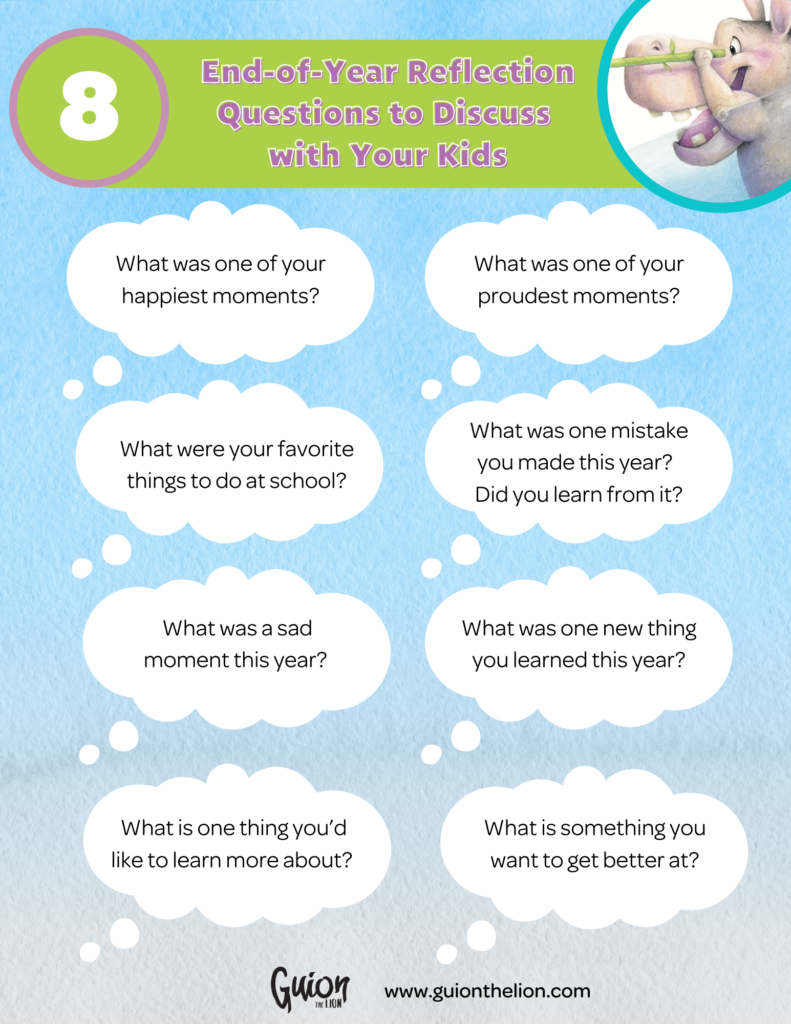
Encourage your kids to assess the year by answering this list of reflective questions. Give them ample time to think about and/or write down their answers before asking them to share with the rest of the family. Let their answers spark conversation about learning from failure and practicing a growth mindset! Happy reflecting!
By: Derek Fordjour, American interdisciplinary artist and educator
Nurturing creative self-expression in children is so important. Why? Because there are many aspects of our lived experience and emotional reality that are too complex and overwhelming to be expressed with words. Fortunately, art enables people to channel their energy– love, hopes, fears, ambitions, sadness and even rage by transferring energy from themselves into raw material. We all have a deep need to feel seen and heard, and art allows both children and adults to experience this viscerally.
I began making art as a child around 3 years old. One of my best therapists observed that it was a space of great empowerment for me because I was in total control and made all of the decisions. From an early age, creative projects gave me a sense of power. Fortunately, this is still very true for me, and can become true for all children if their imagination and artistic expression is encouraged and nurtured through art education.
When a child becomes fluent in artistic expression, they become empowered. And, empowered kids are kind, confident and compassionate kids. Arguably, imagination is one of the single most important attributes in early development. Art education engages the creative mind in ways that liberal arts education simply does not. A comprehensive artistic and cultural education, in addition to core subjects, educates the whole child.
My biggest tip for parents who hope to encourage their kids’ imaginations is to LEAVE THEM ALONE! Yes, I said it. One of the worst things I have witnessed parents do is become overly involved in the artistic expression of their children.
As a fellow parent, I know how difficult it can be to leave a child on their own to work independently–especially when they exhibit great potential. But, if there is one thing I become more and more certain of with time and experience, it is that the creative impulse needs freedom to grow. Encouragement and support are always good, but I encourage parents to do so from a safe distance.
My passion for art education and expression inspired me to launch Contemporary Arts Memphis Summer Fellowship to help young artists imagine their futures as visual artist professionals.
Memphis is a city where, if you are born with musical talent, you can very likely find a path to a professional career as a musician. If you are born with a talent for movement, we have a local ballet company and a modern dance company, as well. If you are born with theatrical talent, we have local theater. However, if you are born with a talent for visual art, there is not a clear path beyond the classroom to help you imagine a future as a visual arts professional.
Contemporary Arts Memphis is uniquely positioned to intervene in the lives of young artists at a crucial stage in their development. We want to expose them to working artists, the best art in the world and to world-class museums. We want to expand their personal networks and help them realize the best possible art at their stage. We are interested in expanding their personal networks, providing mentorship, experiential learning, college level instruction, opportunities for travel, and so much more at no cost. Learn more about the summer fellowship here.
Derek Fordjour was born in 1974 in Memphis, Tennessee to parents of Ghanaian heritage. He earned a BA at Morehouse College before receiving an MEd in Arts Education at Harvard University and an MFA in painting at Hunter College. He was recently appointed the Alex Katz Chair at Cooper Union and serves as a Core Critic at the Yale School of Art. He was named the 2016 Sugarhill Museum Artist-in-Residence and the 2018 Deutsche Bank NYFA Fellow.
Derek’s work has been exhibited in numerous venues including The Whitney Museum of American Art; BAM, Brooklyn; and Josh Lilley Gallery, London. He has received commissions for public projects including a permanent installation for Metropolitan Transit Authority of New York City at 145th Street Subway Station and The Whitney Museum Billboard Project. He was awarded 2016 Sugarhill Museum Artist-in-Residence, the 2017 Sharpe Walentas Studio Program in New York City, and named the 2018 Deutsche Bank NYFA Fellowship Award. His work has been reviewed in The New York Times, Financial Times, The Los Angeles Times, and Hyperallergic. He has also been featured in several publications such as The Wall Street Journal, Vanity Fair and Forbes Magazine. He was recently appointed The Alex Katz Chair at Cooper Union and serves as a Core Critic at Yale University School of Art. His work also appears in several collections including The Studio Museum of Harlem, Brooklyn Museum, Perez Museum, Dallas Museum of Art, The Whitney Museum and LACMA.
By: Rebecca Macsovits, Author of Guion The Lion
The children’s book, Guion The Lion, features two main characters– Rae the Bushbaby, who has more of a fixed mindset in the beginning and Guion The Lion, who showcases a growth mindset. As a reminder, kids with fixed mindsets believe their abilities are fixed traits and cannot be improved no matter how hard they try while kids with growth mindsets believe their talents and abilities can be cultivated through hard work and dedication. Which mindset do you hope your kids have? Personally, I’m shooting for a growth mindset.
I believe teaching kids to have a growth mindset at a young age is so important. This is why I included it as a theme in Guion The Lion. Research suggests that kids with growth mindsets do better in school, have higher self-esteem and are more social. A growth mindset is the difference between, “I can’t do this'' and “I can’t do this, YET.”
Because most children are not born with a growth mindset, it needs to be nurtured and developed. At the beginning of this year, I wrote a blog post sharing tips for nurturing a growth mindset. As the year comes to an end, I want to emphasize the importance of reflection when it comes to building a growth mindset.
Many individuals and families take time to set goals or resolutions for the New Year. But how many of them take the time to reflect on the progress they made in the previous year? Probably not too many. I know I struggle with distraction of the hustle and bustle of the holidays, and it is easy to quickly move on to the New Year without reflection if you’re not intentional.
Reflection is a key link between goal setting and assessment. Reflection helps us learn from failure. Reflection plays an important role in personal growth and goal setting. Of course, we learn by doing, but we can learn even more by doing and reflecting. Our experiences, successes, trials and failures can be our best teachers, if we take time to reflect on them.
The end of one year and beginning of the next offers an opportunity to reflect back before planning ahead. Reflecting as a family can be a great way to intentionally connect and encourage one another while nurturing growth mindsets. Here are a few tips for family reflection:
If you don’t make family reflection a priority, it will never happen. Determine a time that works best for your family to gather and block it off on your calendar. Explain to your kids what to expect and get them excited about spending time together reflecting on the year!
Reflection can be intimidating. Try breaking the ice by looking through family photos from the year and reminiscing about all the memories you made together. This not only breaks the ice and gets your kids talking, but also sparks memories about the events of the year.
Now, time to reflect! Encourage your kids to assess the year by answering a list of reflective questions. Give them ample time to think about and/or write down their answers before asking them to share with the rest of the family. Let their answers spark conversation about learning from failure and practicing a growth mindset.
Last, but not least, guide your kids to setting goals for the year ahead based on what they learned from the previous year and hope to achieve in the future. Next year, you can assess growth based on these goals.
Need help brainstorming family reflection questions? Download 8 reflection questions to ask your kids here. These will help your kids assess what progress they have made and what areas they can still improve on as they look toward the New Year.
Amidst all the holiday hustle and bustle, it’s important to take time to show kindness and compassion for others while guiding the kids in our lives to see beyond their own wishlists and desires.
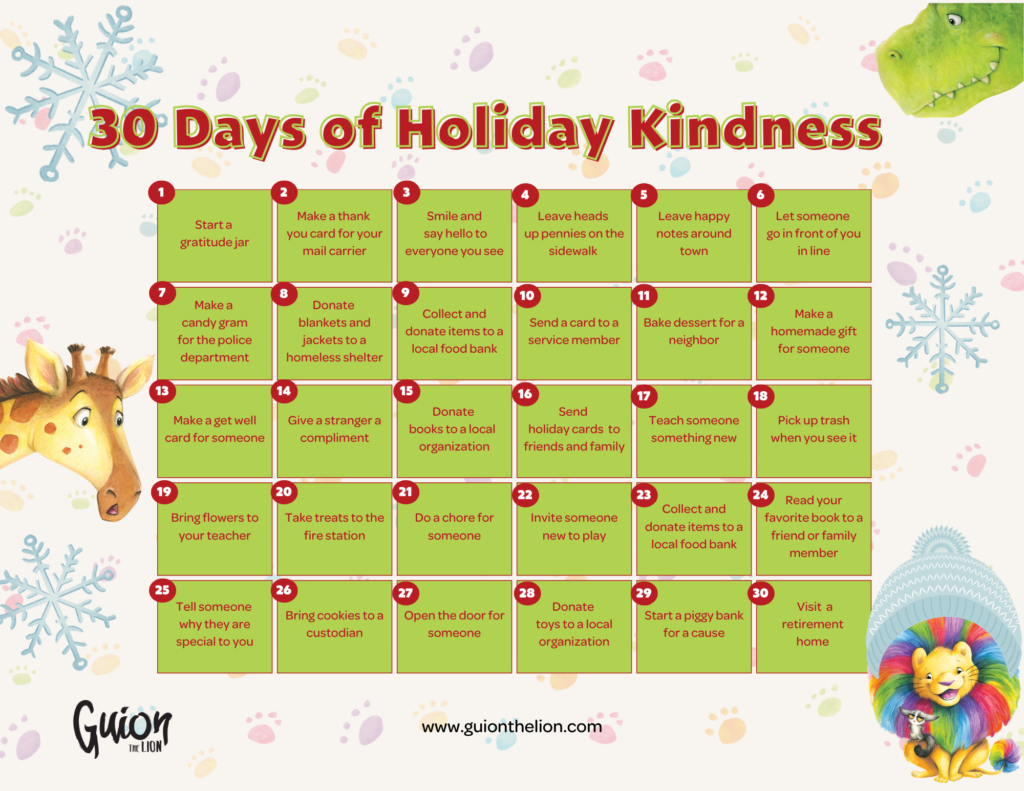
Kindness is a quality we all appreciate and hope our children learn to embrace. What better way to teach and encourage kindness than challenging your family to 30 acts of kindness this holiday season? These small acts of kindness will not only keep your family focused on the true spirit and reason for the season, but also brighten the lives of everyone around you.
Join Guion The Lion in spreading kindness this holiday season. Our 30 Days of Holiday Kindness calendar is a fun and simple way to encourage and teach kindness to your kids.
Looking for holiday activities to do with grandchildren? Grandparents play a pivotal role in the lives of their grandchildren–especially around the holidays. Whether they live nearby or stay in touch from afar, grandparents provide love and leadership that can make a positive impact on their grandchild’s development.
While grandparents often serve as caregivers and teachers, today we’ll focus on their role as playmates! There's nothing more valuable than time well-spent with your grandchildren, but it can be difficult to find things to occupy their time and attention.
Looking for some fun things to do with your grandkids? Check out these ideas for grandparent/grandchild activities to do around the holidays:
Time to pull out the family recipe book! Baking or cooking with grandchildren is a fun, delicious and festive way for grandparents to share skills and family traditions while spending quality time with their little loved ones.
Arts and crafts provide kids with an outlet for creativity and self expression, which can help grandparents get to know their grandchildren a little better. From do-it-yourself ornaments and snow globes to building gingerbread houses and more, there are so many ways to get creative with holiday crafts. Need some inspiration? Check out this list of 50 Easy and Festive Christmas Crafts for Kids.
Whether giving back by volunteering or donating, including your grandchildren in the outing is a great way to teach them about generosity and the importance of giving back to those in need.
Similarly, consider taking your grandchildren holiday shopping with you–but not for themselves. Encourage them to shop for their parents, friends and teachers while you’re out and about. You can also take this opportunity to teach your grandkids about kindness, generosity and how giving to others can be way more rewarding than receiving.
Curl up by a fire and read aloud together. When you read aloud, you are not only helping your grandchildren become readers, but you're also creating memories that will last a lifetime. Holiday-themed or not, let them share their favorite books with you, and you can share a few of your favorites with them!
Does your family have a tradition of playing a certain game around the holidays? From card games and board games to word games and puzzles, there are so many games to play with your grandchildren. Playing games is a fun way to engage with your grandchildren while also teaching them about taking turns and showing good sportsmanship.
Grab some hot chocolate, bundle up and take your grandchildren on a stroll (or a car ride) to look at the festive lights around your neighborhood and city. Your grandkids are likely to be enthralled by some of the neighbors' decorations!
How do you like to spend your free time? Whether it's knitting, playing guitar, gardening, fishing or something else, share the skill with your grandchildren. They will enjoy learning how you spend your time, and you may even introduce them to a new hobby to pursue!
Spread some holiday cheer (and show off your adorable grandchildren) by taking them caroling around your neighborhood. Let them pick a song and spend some time practicing together before you head out.
We hope you enjoy these festive activities with your grandchildren this year. Happy Holidays!
Follow Guion The Lion on Facebook and Instagram and subscribe to the Guion The Lion newsletter for more kid-friendly activities.
